U.S. Recovered Dairy Exports, But Powdered Milk Lost Ground

U.S. dairy shipments grew 2% year-on-year in August measured in milk solids equivalent and generated US$919 million, up 10%. Cheese expanded again, while NFDM/SMP and WPC80+ fell back on limited exportable supply.

U.S. dairy exports post seven months of growth
U.S. dairy exports returned to positive territory in August after two months of decline.

August marked a partial reversal of the 4% combined contraction recorded in June and July, according to data released by the U.S. Dairy Export Council (USDEC). Export value rose 10% from August 2025, while the recovery varied substantially by product category.

Cheese grows 9%, but loses speed
Cheese shipments reached 59,007 tonnes, an annual increase of 9%, or about 5,113 tonnes. It was the first month since March in which exports fell below 60,000 tonnes. USDEC said the price advantage enjoyed by American cheese over international competitors had begun to narrow, after unusually strong growth through much of 2025 and the early months of 2026.

Latin America sustains progress
Latin America supplied much of the cheese growth. Cheese shipments to Mexico increased by 19%, adding roughly 3,095 tonnes; exports to South America rose 35%, or 1,035 tonnes; and deliveries to Central America grew 17%, adding 1,009 tonnes. By contrast, sales to South Korea, the second-largest market for U.S. cheese according to USDEC, fell 12%. Australia declined 10%, while shipments to the Middle East and North Africa decreased 23%.

Milk fat loses strength
Total dairy-fat exports fell 6% year on year in August. Butter shipments dropped 12%, a reduction of 975 tones, while anhydrous milk fat rose 11% and recorded its 26th consecutive month of annual growth. European demand weakened as local supply improved and prices fell. Mexico was a notable exception: U.S. dairy-fat shipments there jumped 1,050% in August, an increase of 2,222 tones. For the year to date, exports to Mexico were up 126%, or 11,318 tones, from the same period in 2025.

Powdered milk is still the weak point
Skimmed milk powder, also known as NFDM/SMP, remained the weakest major category. Exports fell 19%, with the reduction approaching 10,916 tones. USDEC attributed the result mainly to restricted export availability in the United States and less competitive prices. Southeast Asian buyers turned more heavily to New Zealand and the European Union: shipments to the Philippines fell 90%, those to Vietnam declined 85%, and deliveries to Malaysia decreased 78%.

WPC80+ is also limited by the offer
Exports of whey protein concentrate containing at least 80% protein, or WPC80+, shipments decreased 21%, equivalent to 1,422 tones. Brazil recorded a 79% decline, while Japan and Canada reduced purchases by 38% and 25% respectively. USDEC also cited limited export supply for this result. In contrast, milk-protein concentrate exports rose 36% to 5,225 tones, their highest monthly volume in almost four years. Shipments to Brazil increased 533%, adding 673 tones, and sales to Japan rose from 2 tones in August 2025 to 222 tones a year later. USDEC said some producers of protein-fortified foods may be using milk-protein concentrate as an alternative when WPC80+ is less available and more expensive.

Lower-protein whey products also performed strongly. Shipments increased 25%, or 11,487 tonnes, across powdered whey, lower-protein concentrates and modified whey. Canada raised purchases by 183%, while Southeast Asia increased them by 46%. The August figures therefore showed different outcomes within the protein market, with supply, relative prices and the ability to substitute one ingredient for another affecting the distribution of sales. The data covered U.S. exports in August 2026 and were sourced from USDEC.


USDA Opens Dairy Margin Coverage Enrollment For 2027

USDA Opens Enrollment for 2027 Dairy Margin Coverage
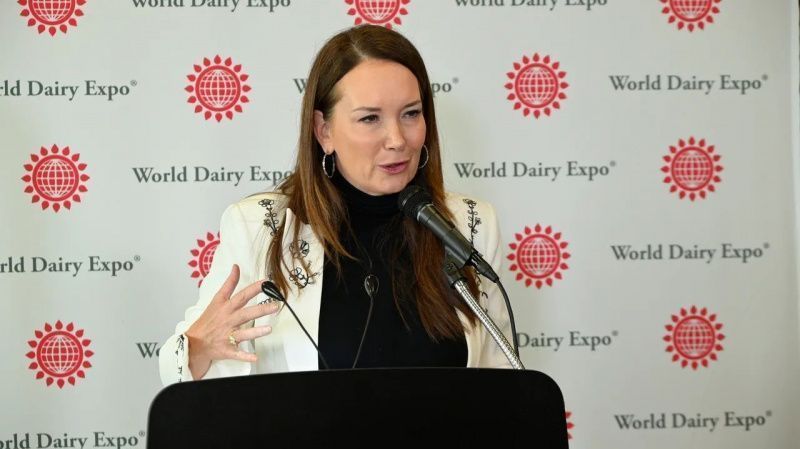
The United States Department of Agriculture said enrollment for the 2027 Dairy Margin Coverage programme will officially run from October 5 through December 18. Agriculture secretary Brooke Rollins announced the schedule during a September 30 visit to World Dairy Expo. The application period is longer than the one-month window used in 2026.

The programme raises the Tier 1 production limit to 6 million pounds and offers a 25% premium discount to producers who maintain coverage through 2031.

Dairy Margin Coverage provides payments when the difference between the national all-milk price and the national average feed-ration cost falls below a margin selected by a producer. Under the programme’s statutory reauthorisation through the Working Families Tax Cut Act, baseline protection is available through the 2031 calendar year.

The revised rules increase the annual milk-production limit for the least expensive Tier 1 coverage from 5 million pounds to 6 million pounds. Producers may also update their historical production records to account for changes such as herd improvements, expanded facilities and higher yields per cow. Farms that commit to uninterrupted protection through 2031 qualify for a 25% reduction in annual Tier 1 premiums.

Farm incomes have faced pressure from the relationship between milk revenue and feed expenses. Producers last received direct programme payments in January and February, while grain-market conditions and soybean-meal prices have affected operating cash flow. Industry projections cited in the source indicate that higher feed costs during the autumn could lead to further payments before the end of the year. The programme allows margin protection up to $9.50 per hundredweight.

Other federal farm measures have expanded eligibility under the Agriculture Risk Coverage and Price Loss Coverage programmes by adding as many as 30 million base acres nationwide. Alfalfa was not included as a primary covered commodity, but producers could assign up to 15% of tillable acreage planted with eligible non-programme crops between 2019 and 2023. Grass hay was excluded from the allocation. The treatment of perennial forage has prompted discussions about possible administrative changes.

US livestock authorities are also gradually restoring cattle movements across the southern border after a 15-month interruption linked to New World screwworm outbreaks. Inspection services have resumed at Douglas, Arizona, and Santa Teresa, New Mexico. A third facility at Columbus, New Mexico, is due to reopen if containment indicators remain favourable. More than 1.5m feeder cattle historically crossed the border each year. A Mexican biosecurity facility is expected to produce 100 million sterile flies by the end of the year, while a second facility in south Texas is planned for launch next spring.

“The containment strategy is working while we build those new facilities,” Rollins said. “The resumption of trade continues. It will take us a while to get back to that 1.5 million head crossing, maybe a couple of years. Until then we will just keep building up.”


Milk Replacers Market Set to Reach $10.1 Billion by 2035

Milk Replacers Market Is Projected to Reach $10.1bn by 2035
Rising demand for precision livestock nutrition, automation and standardized young-animal feeding drives global market expansion.

The global milk replacers market is projected to expand from $4.9 billion in 2025 to $10.1 billion by 2035. The forecast implies a 7.4% compound annual growth rate over 2026–35. Milk replacers are increasingly important in modern livestock nutrition, providing young animals with controlled amounts of protein, fat, vitamins and minerals when whole milk is unavailable, costly or less practical for farm operations.

Dairy production supplies key ingredients

The industry draws on ingredients including whey, skimmed-milk powder, lactose and dairy fats. Global milk production was about 985m tonnes in 2024, of which roughly 797 million tonnes, or 81%, came from cattle. This dairy-processing base supplies manufacturers with ingredients used in milk-replacer formulations.

Non-medicated products represented more than 70% of the market in 2025. They are used for routine calf feeding without therapeutic drugs. Medicated products serve a narrower purpose, combining nutritional support with approved disease-control treatments and requiring regulatory compliance and veterinary oversight.

Join the 2nd MENA Dairy Congress on January 24–25 in Al Ain, UAE — a key meeting point for dairy industry leaders, producers, investors, experts, and technology providers from across the MENA region and beyond.

Discover new market opportunities, exchange expertise, build valuable business connections, and discuss the future of the dairy industry in one of the region’s most dynamic markets.

Register here: https://menadc.dairynews.today

Ruminants and powders dominate

Ruminants accounted for more than 79% of the market in 2025, reflecting the use of replacers in calf-rearing systems. Cattle herds in North America and Europe provide a large recurring customer base, while swine, equine and pet applications include feeding orphaned, weak or nutritionally vulnerable young animals.

Milk-based products captured more than 65% of the market in 2025. Skimmed-milk powder, whey, lactose and whey proteins are used for their digestibility and nutritional suitability. Powder was the leading product form, with more than 88% of the market, supported by its storage, transport, handling and mixing characteristics. Liquid products remain available in ready-to-feed formats, including for farms using automated feeders.

Costs and technology shape product development

Volatility in dairy-protein prices is a challenge for manufacturers. Whey-protein demand from sports nutrition and other food applications competes with animal-feed requirements. Producers are therefore examining blends that combine skimmed-milk powder, plant proteins and other nutritional ingredients. Such formulations can be used to balance nutritional performance, ingredient availability and manufacturing costs.

Automated calf feeders can dispense measured quantities of replacer, reduce manual feeding work and support regular feeding schedules. Farms are also adopting programmes designed around specified early-life growth targets. Premium products may include adjusted protein-to-fat ratios, probiotics and ingredients aimed at gut health. Precision-fermented casein and whey-equivalent proteins remain at relatively small commercial volumes and are being examined as alternative sources of dairy proteins.

Regional and competitive landscape

North America accounted for more than 40% of the global market in 2025. The region has a developed dairy sector, large commercial farms and established livestock-management practices. Asia-Pacific is expected to be among the faster-growing regional markets as dairy production becomes more commercialised and producers in China, India and other Asian countries invest in farm modernisation and structured feeding systems.

Dairy labor shortages affect the preparation and use of milk replacers. Accurate powder measurement, suitable water temperature, equipment hygiene, feeder cleaning and monitoring of young animals are required. Suppliers are offering automated-feeder compatibility, simplified preparation guidance, digital training, remote assistance and farm-level technical support alongside the products.

Companies active in the market include Land O’Lakes, Trouw Nutrition, Cargill, ADM, Denkavit, Lactalis Ingredients, CHS, Milk Specialties Global, Glanbia and Royal FrieslandCampina. Their offerings span calf nutrition, dairy ingredients, animal-feed solutions, feeding technologies and technical services.

If you are looking for more milk replacer offers, check it out here!