Global Consumption Trends In Milk & Mixed Beverages

Global Consumption Trends in Milk and Mixed Beverages
Mixing the milk brings results.

A significant portion of consumers worldwide regularly consume milk and mixed beverages, with new product launches increasing. Key factors influencing purchases include taste, health benefits, and convenience.

In a report by Innova Market Insights, it is revealed that 29% of consumers worldwide consume milk and milk mixed beverages at least once daily, while 35% do so two to six times a week. Over the past five years, there has been an almost 8% increase in new product launches in this category. Global revenue growth from 2024 to 2025 was 4.1%, highlighting the sector’s robustness.

According to ingredients supplier Hydrosol, dairies are leveraging stabilising systems to create innovative products that offer flexibility in formulation. This approach helps them adapt to changing market demands and fluctuating raw material prices without sacrificing quality.

Innova Market Insights identifies taste (52%), health benefits (44%), and convenience (24%) as the primary sales drivers for flavored milk mixed beverages. Personalized health-focused products are becoming increasingly significant, particularly those rich in protein, vitamins, and minerals. Protein-rich products, in particular, have shown a growth rate of 48%, mainly among Generation X and Millennials.

Younger consumers, particularly Millennials and Gen Z, show a preference for products enriched with vitamins and minerals, while older consumers tend to favor beverages with high omega-3 fatty acid content. There is also a demand for reduced fat and sugar content in these beverages.

Dairies are offering various products such as protein-rich milk beverages and innovative hybrid drinks, catering to the diverse needs of different consumer groups. These concepts include carrageenan-free solutions and trending flavors like matcha latte variants, alongside traditional favorites like chocolate and vanilla.

One of the top trends for 2026, as noted by Innova Market Insights, is “Beverages with Purpose.” These products are not only rich in protein and fiber but also fortified with vitamins and minerals to support physical and mental health, gut health, and the immune system. The emphasis is also on healthy aging, weight management, and athletic performance.
 

Washington Allocates $13.8 Million Commerce Investment For Sustainable Dairy Digesters

Washington Allocates $13.8 Million for Sustainable Dairy Digesters
Funding will help reduce methane, wastewater from dairy manure and organic waste

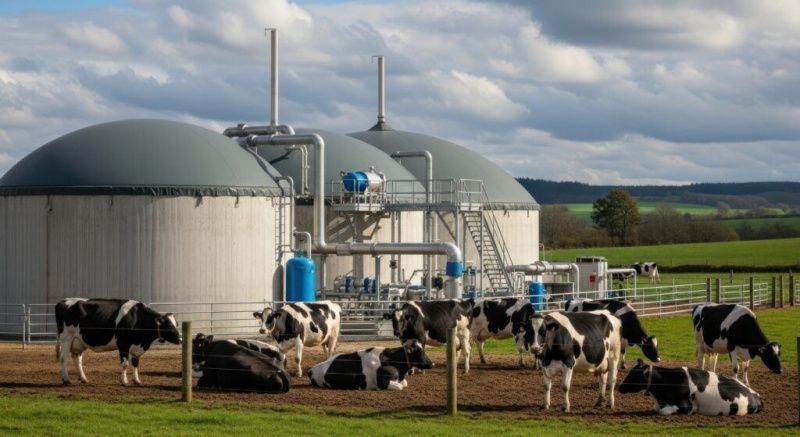
The Washington State Department of Commerce has announced an investment of $13.8 million in seven projects in five mostly rural counties, including one tribal community, to enhance sustainable dairy management. This funding, part of the Dairy Digester Program, aims to build, repair, and upgrade systems that capture methane from dairy manure and organic waste.

Anaerobic digesters, which transform manure and food waste into usable energy, play a crucial role in addressing environmental challenges in Washington, where almost 250,000 cow and goat milk animals reside. These systems not only reduce greenhouse gas emissions but also improve wastewater management and generate renewable energy and nutrient-rich fertilizer, providing environmental and economic benefits.

Sarah Clifthorne, interim director of the Department of Commerce, emphasized the dual benefits of these projects, stating, “These dairy projects cut emissions and boost the resiliency of rural communities. They’re a smart, practical way to deliver cleaner air and water, while creating new economic opportunities for Washington farmers.” Over the next decade, these initiatives are projected to reduce greenhouse gas emissions by over 1 million metric tons of carbon dioxide and capture more than 7,400 tons of waste runoff.

The projects include a $2.53 million anaerobic digester construction in Franklin County by 5D RNG LLC and a $4.65 million upgrade of existing digester facilities by the Tulalip Tribes of Washington in Snohomish County. Other projects involve upgrading outdated systems, constructing new digesters, and implementing nutrient recovery technologies.

Funding for these projects was sourced from the Climate Commitment Act (CCA) capital funding and the Clean Energy Fund. An additional $9.7 million has been allocated for future dairy digester projects in the 2026 supplemental budget.

The program also benefited from community feedback through a Request for Information and public listening sessions, shaping its focus on cost-effective methods like cover-and-flare projects that are suitable for smaller dairies. These projects are aligned with Washington’s agricultural conditions and aim to minimize transportation impacts

Additionally, $500,000 has been appropriated to the Washington State University Energy Program to provide technical expertise and support to these projects. This investment is expected to enhance the long-term sustainability of on-farm digesters and connect producers with necessary research and resources.


Transformation Of US Dairy Industry Over 250 Years

How US Dairy Achieved Global Nutrient Leadership
In the 250 years since the founding of the United States, no agricultural sector has undergone a more profound structural transformation than dairy processing and production. From 1776 homesteads to 2026 data hubs, 250 years of innovation transformed US dairy into a global leader in nutrient density.

The dairy industry has undergone a significant transformation over the past 250 years, evolving from small family farms to large-scale, high-tech operations. Modern mega-dairies are now equipped with advanced technologies, enhancing efficiency and sustainability.

The US dairy industry has experienced a profound transformation since the country’s founding in 1776. Initially, dairy production was a local, survival-driven necessity, with families keeping cows to provide essential nutrition. Over the next two and a half centuries, the industry evolved into a sophisticated network of high-tech, corporate mega-dairies.

By 2026, the traditional homestead model had been replaced by advanced commercial operations, with facilities milking over 1,000 cows. These modern production sites are equipped with real-time sensor platforms that allow herd managers to monitor animal health and nutrition with precision, a significant leap from the manual labor of the past.

Technological advancements have led to the development of crossbred animals designed to meet specific cheese production needs in international markets. The integration of large-scale anaerobic methane digesters and nutrient-recovery systems has transformed dairy operations into potential net-positive energy producers for local communities.

Despite these changes, the industry’s core remains tied to multi-generational family farming legacies. Daily routines on farms continue to reflect the silent, practiced choreography of livestock management that has defined the sector for generations.

By the turn of the 21st century, the industry had hit a staggering milestone of efficiency. As Dennis Rodenbaugh, chair of the Innovation Center for U.S. Dairy, recently noted, the modern U.S. dairy cow is a biological marvel. Compared to her midcentury predecessors, she produces five times more nutrition while using 65% less water and requiring 90% less land. We have spent 250 years perfecting the “how” of production. Now, we are entering the “why” of the digital era.

The industry’s progress is marked by the construction of modern manufacturing facilities, which serve as symbols of the new era. These developments have positioned American dairy producers as leaders in global nutrient supply, demonstrating a commitment to innovation while maintaining traditional roots.